Last summer I travelled to Yunhe in southern China to see the famous terraced fields and watch the sunrise. I woke before dawn, the air still cool and the village quiet, and walked up a narrow path toward the highest viewing point. Village houses faded behind me as the sky lightened from deep indigo to pale blue.
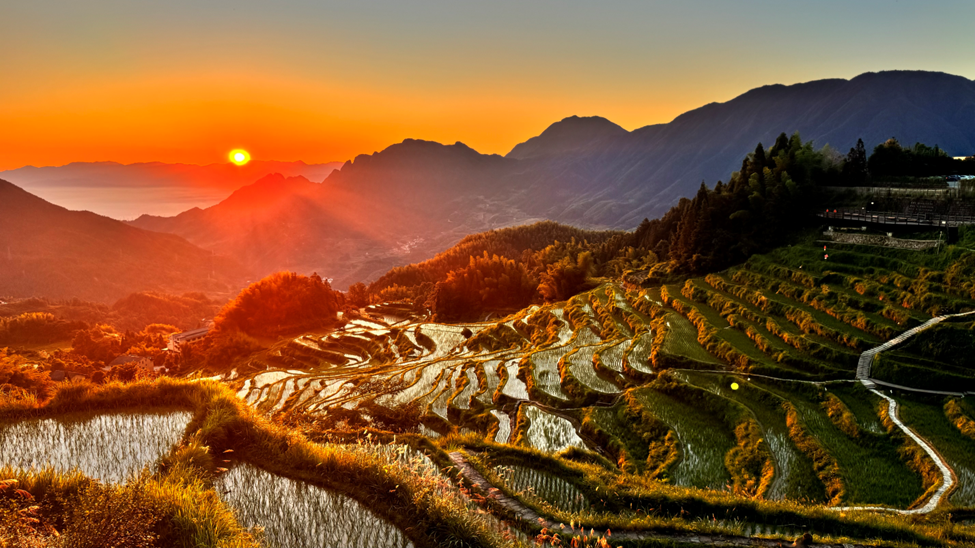
As I reached the terraces, a thin veil of mist hovered over the paddies, and the layered slopes seemed to float between earth and sky. Some farmers were already at work, their silhouettes small against the vast pattern of carved steps. I found a stone ledge to sit on and waited, heart quick with anticipation. The horizon brightened slowly, and first a faint band of gold appeared, then the sun peeked above the distant ridge, spilling warm light across the terraces.
The morning transformed the landscape. Each flooded terrace became a mirror, reflecting the changing colours of the sky: soft pinks, blushing oranges, and finally clear, brilliant yellow. The clouds that had rested in the valley began to drift and dissolve, revealing green shoots of rice and the dark, wet soil between them. The scene felt both immense and intimate: vast fields shaped by centuries of human hands, yet focused into a single slice of time by the rising sun.
Local villagers greeted the day with quiet routines: watering channels filling, birds calling, and the distant clack of tools. I took photos, but mostly I listened: the gentle hiss of flowing water, the rustle of leaves, and the collective breath of a landscape awakening. Standing there, I felt connected to something older than my itinerary: a rhythm of seasons and simple, persistent labour.
After the sun rose fully, the terraces glowed with renewed life. I lingered, savouring the light and the sense of calm, grateful that my summer journey led me to that luminous morning in Yunhe. The memory of that sunrise remains one of the clearest, most peaceful moments of my travels.